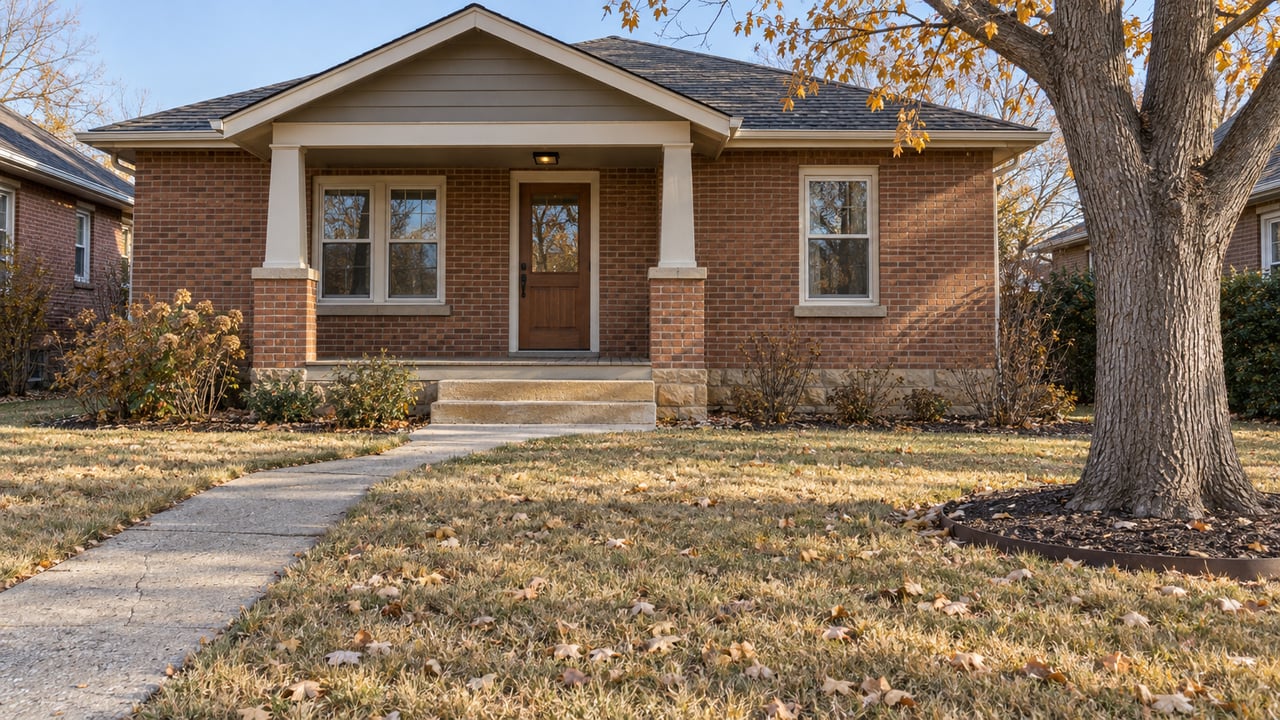
Two Wellington homes with the same square footage, on the same 3/4-inch water tap, can have very different monthly utility bills. Most of the gap comes from two things a listing never shows. The first is how much water the household used in January, February and March. The second is where the lawn water comes from.
Both come from the Town of Wellington's own rate rules, and both apply in 2026. The sewer rule matters for anyone who owns a home this winter. The irrigation rule matters most in July, but the time to learn it is before you choose a street.
The Sewer Charge Rests on Three Winter Months
Under Ordinance 01-2026, adopted February 24, 2026 and effective April 1, 2026, Wellington charges residential wastewater a $15.25 monthly base. On top of that comes $10.46 per 1,000 gallons of average monthly water use in the January, February and March billing periods, rounded up to the next whole thousand. The same ordinance sets residential stormwater at $6.25 a month.
The volume part of a household's sewer charge, then, comes from three billing periods. In its February 24, 2026 Board memo, the Town calls this average winter consumption and says the approach "is consistent with industry best practices." The logic is simple. Winter water mostly goes down the drain, so it's a fair stand-in for what the sewer system actually treats.
Here is how the 2026 rates work out at a few winter averages:
| Average monthly use, Jan–Mar | Gallons billed after rounding | Monthly wastewater charge |
|---|---|---|
| 3,200 gallons | 4,000 | $57.09 |
| 4,000 gallons | 4,000 | $57.09 |
| 4,100 gallons | 5,000 | $67.55 |
| 6,000 gallons | 6,000 | $78.01 |
Look at the jump between the second and third rows. An extra 100 gallons a month across that window moves the billed volume up a full thousand gallons, about $10.46 more every month. A dripping toilet, houseguests in February, or a winter project that runs a lot of water all count toward the average.
For a buyer, timing comes into play. If you close in the late fall or early winter, your own household's use goes into the January through March window. If you close in spring, the window is already over.
Fort Collins and Windsor Set Sewer Charges Differently
If you're comparing Wellington with nearby towns, the way each town sets the sewer charge differs as much as the rate does:
- Wellington averages the January, February and March billing periods and rounds up to the next 1,000 gallons, as above.
- Fort Collins Utilities uses a December, January and February winter quarter average. Its residential rates page lists a 4,000-gallon average for single-family customers who don't yet have an established winter quarter average.
- Windsor's fee schedule, updated February 1, 2026, lists a $48.08 monthly sewer charge for single-family homes and uses winter-average volume charges only for commercial and industrial accounts.
In Windsor, a winter of heavy water use doesn't change a single-family sewer bill. In Wellington and Fort Collins, it does. Where in winter the window falls also differs by town.
In Summer, the Irrigation Source Sets the Bill
Wellington residential potable water rates did not change in 2026. The Town's fee schedule, effective April 1, 2026, still lists single-family water rates under Ordinance 11-2024. The February staff memo had recommended a 3% cut to residential water service charges. The adopted ordinance's residential water section reads "Removed," so the cut never took effect.
A 3/4-inch single-family tap pays a $54.81 base. Rates per 1,000 gallons climb by tier:
- 0 to 3,000 gallons at $0.00
- 3,001 to 7,000 gallons at $12.90
- 7,001 to 20,000 gallons at $16.76
- More than 20,000 gallons at $23.86
The tiers are why the lawn matters so much. Watering a yard with Town potable water adds gallons on top of indoor use, so nearly every gallon of it lands in the third or fourth tier. In a 15,000-gallon month, a home pays $54.81 base, $51.60 for tier two and $134.08 for tier three, about $240 in all. Ten thousand gallons of that summer watering at the tier-three rate costs $167.60.
The same fee schedule lists Town non-potable irrigation at a $0 base and $1.10 per 1,000 gallons. At the Town's rate, those same 10,000 gallons cost $11.00. Many neighborhood systems aren't billed by the Town, though. At a June 2021 Board meeting, trustees described subdivision non-potable systems as generally fed by wells and outside the Town's jurisdiction. For those, what a homeowner pays for yard water depends on whoever runs the system, often through HOA dues or a separate charge, not the Town's rate.
The Town publishes a Potable / Non Potable Irrigation Systems map. It covers Buffalo Creek, Wellington Pointe, View Pointe, Park Meadows, Sage Meadows, The Knolls, Sundance and other neighborhoods, coded by irrigation source and by whether an HOA is involved. The map shows the most about a home's summer water costs of anything the Town publishes.
The Same Split Shows Up in New Construction Fees
New construction in Wellington uses the potable/non-potable split too. Ordinance 02-2026, effective April 1, 2026, sets the single-family water capital investment fee at $16,312 when irrigation uses Town potable water. When irrigation comes from another source, the fee is $7,340. The single-family wastewater capital investment fee is $13,363.
Raw water follows the same pattern. The Town's raw-water contribution schedule says that when a subdivision has a non-potable irrigation system, the contribution covers indoor use only. A 2021 staff memo said residential subdivisions then under construction had non-potable well-water irrigation. It also said existing development agreements had typically cut the combined raw-water requirement for those systems by 50%. The requirement still comes up in practice. In March 2026, Town staff reported closing on one North Poudre Irrigation Company share to meet the raw-water dedication for homes in Sage Meadows Second Subdivision.
At every stage, the Town charges less when yard water comes from somewhere other than its treatment plant. That holds for the one-time connection fee, the raw-water dedication and the monthly bill.
Why the Wastewater Line Keeps Moving
The treatment plants explain why sewer rates went up this year. According to North Forty News, Wellington's water treatment plant and water reclamation facility expansions cost $92.2 million combined: $39 million for the water plant and $53 million for the reclamation facility. Funding came from low-interest Colorado State Revolving Fund loans, the Water Enterprise Fund and reserves. The same report put water plant capacity at 4.2 million gallons per day, up from 2. Reclamation capacity rose to 1.8 million gallons per day, up from 0.9.
Paying off that debt puts pressure on rates. The same Board memo says the wastewater utility needs more revenue to cover operating costs, reserve targets and debt service coverage. It cites a Raftelis financial plan with an 18% rate revenue increase in 2026, followed by 10% in 2027 and 8% in 2028. The 2027 and 2028 figures are plan projections, not adopted rates. The Town's second-quarter 2026 strategic plan update says a three-year update to the 2022 Utility Rate and Fee Study is underway.
Stormwater is changing too. The 2026 rates updated the Town's drainage fee for the first time since 2017. Staff also built the rates around the expected sunset of the Boxelder Basin Regional Stormwater Authority and its separate drainage fee. The model assumes the Authority closes by the end of 2026, though the memo notes the actual closure could slip into 2027.
Questions to Ask About a Specific Wellington Address
These questions help put a number on a home's real monthly cost before you're under contract:
- Where does the yard water come from? Find the neighborhood on the Town's irrigation map, then ask who operates the system and how homeowners are charged for it.
- What did the winter bills look like? January through March statements from the current owner show the sewer volume the home has been carrying.
- What size is the water tap? The single-family base charge runs from $54.81 for a 3/4-inch tap to $132.97 for a 2-inch tap.
- When will the account change hands? The Town lists a $10 account transfer fee. A closing date before or after the January through March window decides whose water use sets the sewer volume.
Utility rates, fees and HOA charges change, and this post is general information, not legal, tax or financial advice. Confirm the details for a specific property with the Town, the HOA or the right professional.
Seth Hanson spent years in construction and property management before building LiveInNoCo. He reads the irrigation map, the tap size and last winter's utility bills the same way he reads the listing price. If you're weighing a Wellington home and want the real monthly cost before you write an offer, let's connect.